
Cloud Phone Systems for Businesses Explained
Cloud phone systems for businesses: how SMEs benefit from flexible telephony, better availability, and predictable costs every day.
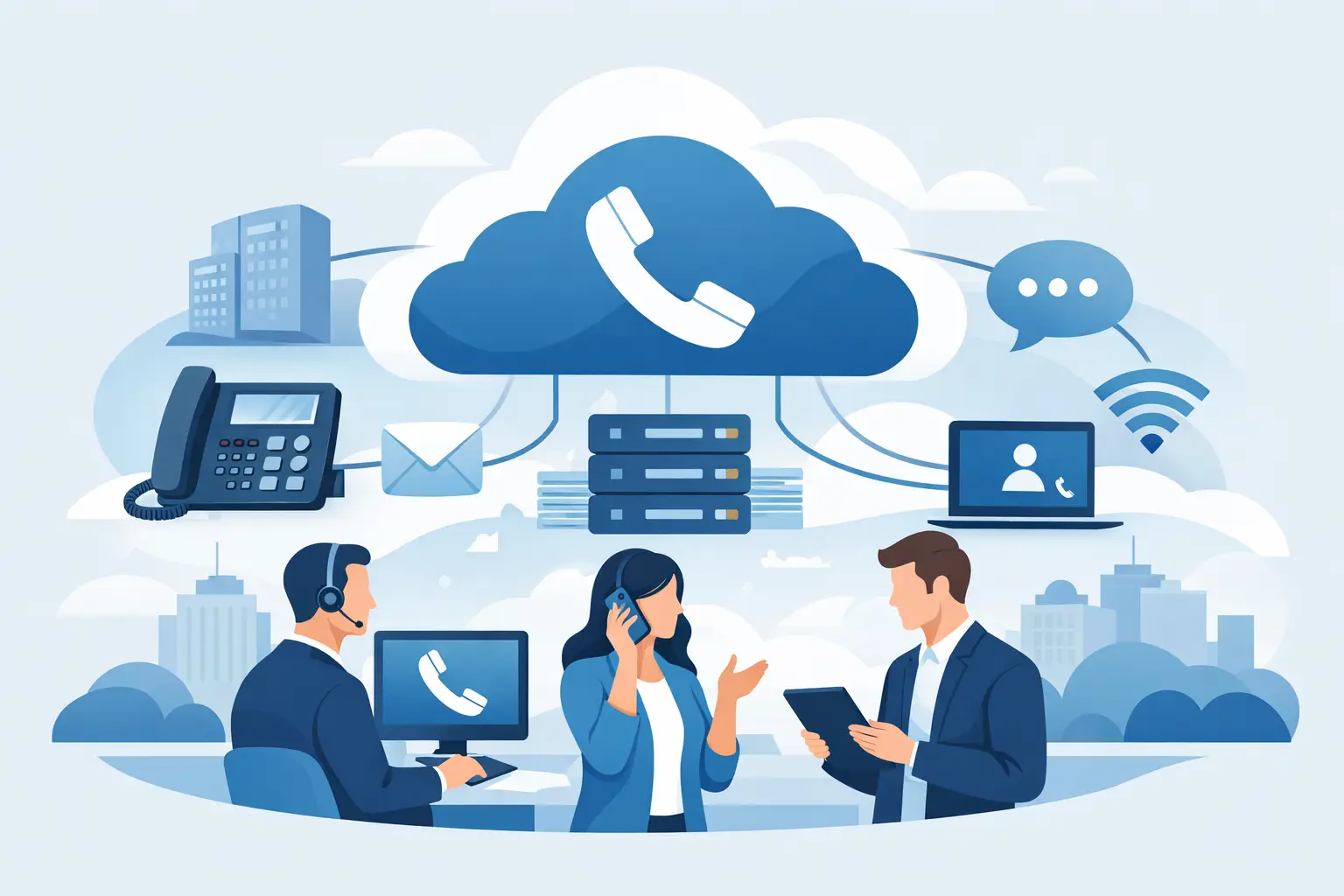
Anyone who needs to be reachable today at the office, in the home office, and on the road quickly notices how inflexible traditional phone systems have become. This is exactly where the topic of cloud phone systems for businesses becomes relevant: not as a technology trend, but as a practical answer to changing work patterns, rising service expectations, and the desire for predictable IT costs.
For small and medium-sized businesses, a modern telephony solution above all needs to do one thing: work reliably without adding complexity to daily operations. Customer calls, internal coordination, call forwarding, mobile availability, and connecting multiple locations shouldn't be an organizational obstacle. A cloud phone system can simplify exactly that — if it fits how your company actually works.
What a cloud phone system for businesses really delivers
At its core, a cloud phone system replaces the traditional on-premises PBX with a hosted solution. Telephony no longer runs over locally installed infrastructure with high maintenance overhead, but over a platform hosted in a data center. For many companies, that's appealing because hardware, upkeep, and expansion become significantly easier.
The bigger advantage, though, usually isn't the technology itself, but the operations. New extensions can be set up faster, employees can work under their usual number regardless of location, and adjustments are possible without elaborate rebuilding. This is often the decisive point for growing businesses or companies with field staff, part-time arrangements, or home-office work.
At the same time: a cloud solution isn't automatically better just because it sounds modern. If the internet connection is unstable, internal processes are unclear, or nobody defines how availability should be organized, new problems arise elsewhere. That's why the decision should never be based solely on price or a feature list.
Which companies benefit most from this solution
A cloud phone system is especially worthwhile for companies that work flexibly and no longer want to tie their communication to a single location. That applies to trade businesses with an office and field staff just as much as to law firms, medical practices, service providers, agencies, or mid-sized trading companies with several teams.
Companies whose existing phone system has aged also often benefit from switching. If replacement parts are hard to get, expansions become expensive, or administration only works with specialist knowledge, that's a clear signal. At the latest by then, it's worth looking at a future-proof alternative.
Pure cloud telephony can be less suitable if a location permanently lacks a stable connection, or if highly specialized legacy systems need to be connected that have only limited compatibility. In such cases, a careful review is needed rather than a quick decision. This is exactly where the value of vendor-neutral advice shows.
The most important benefits in daily work
In day-to-day business, what counts isn't buzzwords but noticeable relief. In many companies, a cloud phone system first improves availability. Calls no longer go unanswered just because someone changed desks or is working from home at short notice. Call groups, forwarding, and presence features help route customer inquiries to the right person faster.
There's also better scalability. As your company grows, new employees start, or additional locations are added, the solution can be adapted without major investment. That's more economical than a system that's already too small — or unnecessarily oversized — today.
Another advantage is predictable costs. Instead of high one-time investments, monthly, well-plannable fees usually take center stage. For many SMEs, that's more comfortable because it fits communication costs more easily into ongoing operations. Still, it's worth taking a close look at the pricing model. Cheap to start with doesn't automatically mean cheap in daily use, if features, devices, or support are billed extra later.
What companies should look for when choosing
The right solution doesn't start with the provider, but with the requirements. How many workstations need to be connected? Is there just one office or several locations? Do employees work mobile? Are group numbers, queues, or time-based routing needed? Should softphones be used on laptops, or should classic desk phones remain in use?
Small and medium-sized companies in particular often underestimate how closely telephony is tied to their workflows. Who takes first calls? What happens during vacation or illness? Which department needs fixed extensions? How are emergencies or outages handled? A cloud phone system only works well once these questions have been clarified in advance.
Technically, the connection above all needs to be checked carefully. Without sufficient bandwidth and stable network quality, voice quality suffers. The internal network matters too. If data traffic and telephony interfere with each other, even the best platform won't help much. That's why analyzing the internet connection, firewall, network structure, and endpoint devices should always be part of the rollout.
Cloud phone systems for businesses and security
As soon as communication runs over external platforms, security rightly comes under closer scrutiny. Companies want to know where data is processed, how access is protected, and what happens in the event of a failure. These questions are legitimate and should be answered openly.
First, it's important that the solution is operated professionally and meets clear security standards. That includes encrypted connections, secured user access, traceable permission concepts, and a resilient operating model. The organizational side matters just as much: who is allowed to change settings, who manages call forwarding, and how are mobile devices secured?
Resilience also depends on the overall concept. A cloud phone system can run very stably, but it depends on network availability. Companies should therefore check which fallback scenarios make sense. In some environments, mobile network backup is enough; in others, clearly defined fallback processes are needed for individual teams or locations.
Rolling out without disrupting ongoing operations
Switching to a new telephony solution doesn't have to be complicated if it's planned in a structured way. What matters is that the technical transition and daily operations are properly coordinated with each other. Number porting, devices, user profiles, and training all need to mesh.
In practice, a clear project process works well. Requirements are gathered first, followed by technical review. The target structure is then set up, tested, and only then rolled out. Especially for SMEs, it's important that employees quickly understand how to answer calls, forward them, or work on mobile. A good solution isn't recognized by how many features it has on paper, but by how easy it is to use day to day.
A partner who not only sells but also implements, supports, and stays reachable pays off here. WSV Systemhaus supports companies not just in choosing a solution, but also in setup, support, and ongoing operations. That's especially valuable when telephony is part of a broader IT strategy and network, security, and cloud services need to work together.
Common mistakes when deciding
Many problems don't come from the cloud phone system itself, but from false expectations. A common mistake is focusing purely on price. If only the monthly fee is compared, setup effort, support quality, and expansion options often get left out.
It's just as critical to carry old structures over unchanged into a new environment. If you previously had unclear cover arrangements or poorly organized call groups, you simply bring those weaknesses along otherwise. The transition is therefore also an opportunity to organize communication more cleanly.
A third point concerns responsibility in operations. Even though the platform is hosted externally, you still need fixed internal points of contact. Someone has to coordinate changes, manage users, and consolidate requirements. Otherwise, a flexible solution quickly turns into a collection point for individual wishes with no clear direction.
When consulting is especially worthwhile
At the latest once multiple locations, mobile teams, or existing systems need to be taken into account, the selection process shouldn't run as an afterthought. At that point, it's no longer just about telephony, but about availability, service quality, and work organization. For managing directors, this is an economic topic; for IT decision-makers, an infrastructure topic; and for office managers, often a question of daily workflow.
Good advice therefore doesn't just look at features, but at actual benefit. Which solution relieves your team? Which option will still fit in three years? Where are the security or operational risks? And which investment is genuinely worthwhile rather than just cheap in the short term?
If you want to modernize your communication, you don't need a complicated technical debate, but a solution that fits your company, runs reliably, and grows with you. That's exactly where it's decided whether a cloud phone system is just a new system — or a real improvement in daily work.