
Stopping Cyberattacks on Small Businesses
Cyberattacks on small businesses often hit unexpectedly. Here's how to reduce risk, protect data, and keep your business able to act.
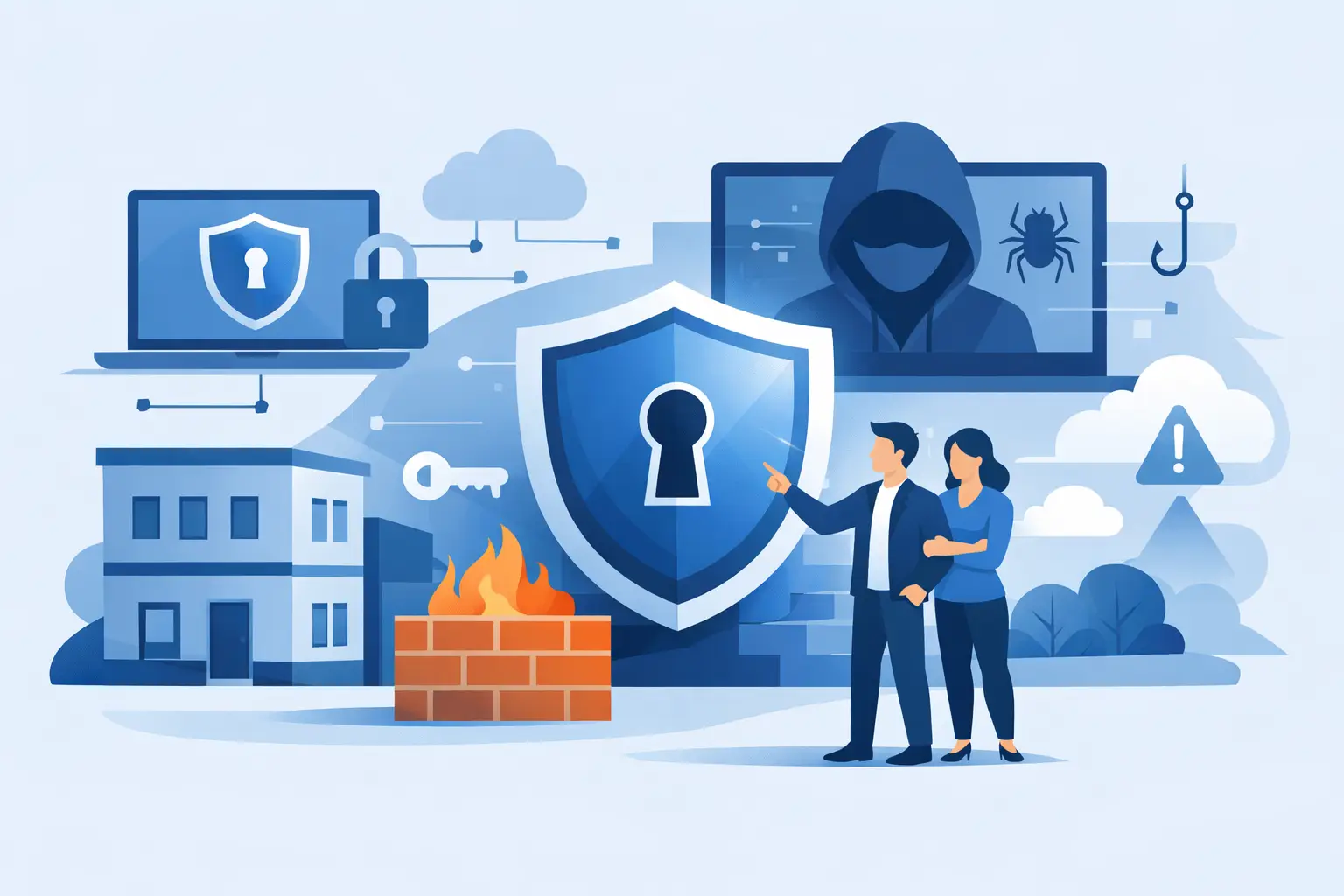
A Friday, 4:40 p.m., the team wants to head into the weekend — and suddenly quotes, invoices, or customer data can no longer be opened. A ransom demand appears on the screen. This is exactly how many cyberattacks on small businesses begin: not spectacularly, but in the middle of daily operations, when there's no time for downtime and every hour counts.
For small and medium-sized businesses, this risk is no longer a niche topic. Attackers don't just target large corporations — they specifically target businesses with limited IT resources, organically grown structures, and high time pressure. A trade business, a law firm, a manufacturing company, or a 15-person office is often easier to attack than a corporation with its own security department. What matters, then, isn't whether an attack is attempted, but how well your company is prepared for it.
Why cyberattacks on small businesses succeed so often
Many managing directors assume their business is too small or too insignificant for cybercriminals. That very assumption is the problem. Today's attacks are largely automated. There's no lengthy research into whether a company has 20, 200, or 2,000 employees. If a vulnerable remote access point, a poorly secured mailbox, or an outdated server is found, that's often enough.
There's a second point too: in small companies, IT above all just needs to work. That's understandable. New employees need a workstation quickly, systems need to be reachable, printers need to run, and there's little room in daily business for security concepts. This creates gaps that go unnoticed for years — weak passwords, missing updates, unclear permission assignments, or backups that exist but can't be cleanly restored in an emergency.
The human factor also remains central. A convincingly fake email from a supposed supplier, an invoice with an infected attachment, or a message from "management" with an urgent payment instruction is often enough. Technically, the attack doesn't even need to be particularly sophisticated. It just needs to look credible at the right moment.
The typical entry points in SMEs
Not every attack follows the same pattern. Even so, practice shows some recurring weaknesses. Especially common are phishing emails, compromised passwords, open or poorly secured remote access, and unpatched systems. The risk rises significantly in environments that have grown organically, with older servers, several branch offices, or makeshift solutions from the pandemic era.
Mobile devices and personal devices used for business are another entry point. When smartphones, laptops, or tablets are used for work without being centrally managed, IT quickly loses track. It then becomes unclear which devices are up to date, which apps have been installed, or whether data can be remotely wiped in case of loss.
It also gets critical where security solutions exist but aren't actively maintained. A firewall alone doesn't automatically protect you. What matters is whether rules are properly maintained, logs are reviewed, and anomalies are detected. Security isn't a state you buy once. It's ongoing work.
What a successful attack really costs
When thinking about cyberattacks, many first think of data loss or ransom. In reality, the damage is often broader. If email, inventory management, telephony, or production go down, it's not just IT that stands still — the whole business does. Quotes don't go out, orders sit unfinished, customers can't reach anyone, and internal workflows stall.
Then there are follow-up costs that are often underestimated. Systems need to be analyzed, cleaned, and rebuilt. Employees are tied up, external specialists get called in, and the actual work piles up. Depending on the industry, reporting obligations, data protection issues, or reputational damage can add to it. For small businesses, the absolute sum matters less than the question of how long the business can even sustain an outage.
There's an important difference between cheap and economical. Anyone who cuts corners in the wrong places pays twice in an emergency — in money, time, and trust.
Making cyberattacks on small businesses genuinely harder
The good news: small companies don't need to build corporate-scale structures to significantly reduce their risk. It's not about maximum complexity, but about sensible protective measures that fit the business and are sustainable in daily operations.
The first lever is transparency. If you don't know exactly which systems, user accounts, devices, and access points are in use, you can hardly secure them properly. An inventory usually quickly reveals where legacy items, unnecessary permissions, or outdated components exist. Especially in smaller environments, this step often achieves more than the next individual product purchase.
Next comes basic technical security. That includes up-to-date systems, professionally managed endpoint protection, a properly configured firewall, secure remote access, and multi-factor authentication for critical accounts. Not every measure needs to be rolled out everywhere at once. But for admin access, email accounts, and externally reachable systems, there should be little room for debate.
A reliable backup concept is just as important. Backups only help, though, if they're protected separately from the production system, checked regularly, and can be restored quickly in an emergency. Many companies only discover after an incident that backups were incomplete or recovery took too long. At that point, an IT problem quickly becomes a business problem.
The point where technology alone isn't enough
Even good systems don't prevent every mistake. That's why employees need guidance, not a culture of fear. Anyone who reports suspicious emails, takes unusual login alerts seriously, or briefly double-checks before an urgent payment is actively contributing to security. But that only works if responsibilities are clear and security rules are written in a way that fits everyday use.
In small businesses, a pragmatic framework is often enough: which attachments may be opened? How are passwords managed? What should be done with suspicious emails? Who decides on an unusual payment request? Once such questions are clarified, the risk drops noticeably.
A sense of proportion matters here. Overly rigid rules get bypassed in daily work. Overly loose guidelines don't help. Good security processes need to support day-to-day business, not slow it down.
What matters in an emergency
When an attack happens, speed matters — but panic hurts. Companies need a clear process for the first few hours. Who gets informed? Which systems get isolated? Who's allowed to decide? Which external partners are on standby? Without this framework, valuable time is lost.
Small businesses in particular benefit from having a fixed point of contact that doesn't need to be found only once a crisis hits. An incident is rarely the right moment to sort out responsibilities, contracts, or technical access. Deciding in advance how to respond reduces downtime and uncertainty.
This also includes the honest question of which systems need to come back online first. In some businesses, that's the ERP system; in others, telephony, document access, or the production environment. This prioritization makes the difference between a controlled resumption and an improvised restart.
Security needs to fit the size of the company
Not every company needs the same security architecture. A business with ten workstations has different requirements than a manufacturing company with several locations, field staff, cloud services, and industry-specific requirements. Even so, the same applies to both: standard solutions that ignore actual workflows often fall short.
That's why it's worth building a security strategy that grows with the company. Today, solid basic protection with a managed firewall, professional antivirus, online backup, and clearly regulated access may be enough. Tomorrow, MDM for mobile devices, cloud security, monitoring, or documented emergency processes may be added. The right path isn't always the most extensive one, but the one your company can consistently implement and operate.
That's exactly where the value lies in a partner who doesn't just deliver products, but understands your environment, realistically assesses vulnerabilities, and prioritizes measures. For many SMEs, that's far more sensible than investing on a hunch in individual tools that nobody properly maintains afterward.
From a security project to ongoing operations
Cybersecurity isn't a one-time measure you check off. New employees join, software changes, locations grow, processes move to the cloud, and legal requirements increase. What's sufficient today might not be enough in twelve months.
That's why IT security works best as an ongoing process. Systems are monitored, updates planned, backups tested, permissions reviewed, and anomalies assessed. That sounds like a lot of effort, but in practice it's often the most economical path — especially when internal resources are limited. A regional IT partner like WSV Systemhaus GmbH can provide relief exactly there: with vendor-neutral advice, tailored managed services, and a focus on what's actually relevant for your business.
Taking cyberattacks on small businesses seriously doesn't mean falling into panic. But looking away isn't a strategy either. Often, a few well-coordinated steps are enough to make attacks significantly harder and to stay able to act in an emergency. That's what it's really about: not perfect theory, but IT you can rely on precisely when it matters.