
Firewall as a Service for SMEs Explained
Firewall as a Service protects SMEs centrally, flexibly, and predictably. How to tell when the model fits your IT and your risk profile.
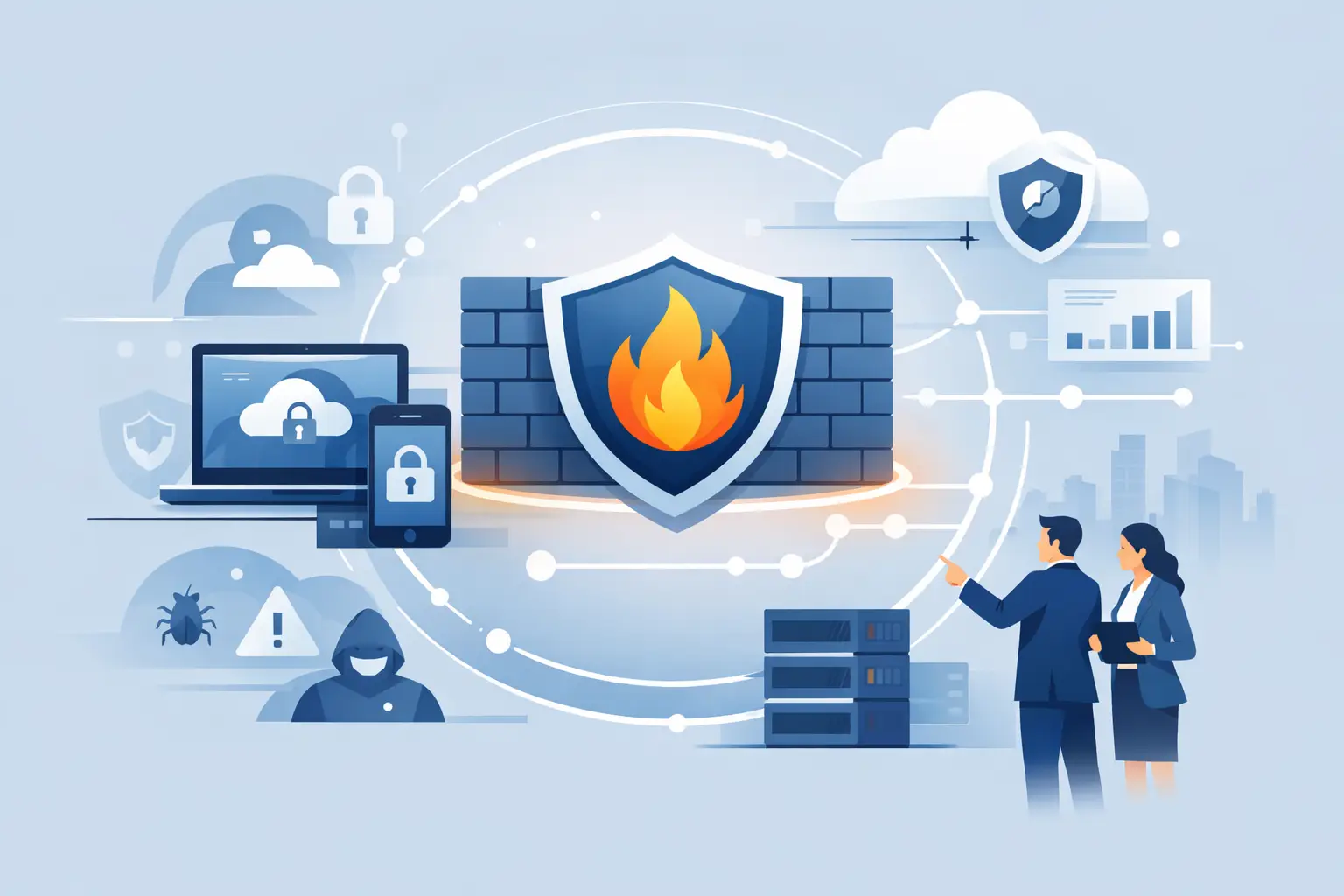
When employees access the same systems from the office, the home office, and on the road, a traditional firewall at the company site is often no longer enough. This is exactly where Firewall as a Service becomes interesting. The model moves central security functions into a managed cloud environment and ensures that protective rules apply not just at the site, but wherever your users, devices, and applications actually work.
For many small and medium-sized companies, this isn't a theoretical future topic, but a very practical question: how can security be improved without putting extra strain on internal IT? Anyone planning with limited resources, running multiple locations, or making heavier use of cloud applications generally doesn't need more complexity, but a solution that runs reliably, is properly managed, and adapts to changing requirements.
What Firewall as a Service actually means
Firewall as a Service, often abbreviated as FWaaS, is a firewall solution that's delivered and centrally managed as a service. Unlike a purely local appliance, the security logic doesn't just sit in your server room or network cabinet. Instead, data flows, access, and security policies are checked, filtered, and controlled through an external platform.
At first, that sounds like a purely technical shift. In practice, though, it's about something else: the firewall no longer orients itself only around a fixed company location, but around the actual communication paths of your business. When employees access Microsoft 365, ERP systems, or other cloud services directly from the home office, a local firewall can often only control those connections to a limited extent. A service-based firewall addresses exactly this gap.
Depending on the provider and architecture, the model includes classic functions such as packet filtering, application control, web filtering, intrusion prevention, malware protection, and logging. The decisive difference lies less in the feature list and more in the operating model: management, updates, policy changes, and often monitoring too run centrally and predictably.
Why the model is gaining importance for SMEs
Many organically grown IT environments in mid-sized companies still follow a simple pattern: one main site, one internet connection, one firewall, with the internal network behind it. That picture often no longer fits today. There are branch offices, mobile devices, cloud telephony, SaaS applications, and external service providers with temporary access.
This shifts the security boundary. It no longer sits cleanly at the transition between the company building and the internet. Anyone who still relies exclusively on classic site-based logic quickly creates gaps, detours, or unnecessary administrative effort. Traffic, for example, then gets routed back into the company network just so it can be checked there. That costs performance and makes the architecture unnecessarily complicated.
Firewall as a Service can help here, because security policies are delivered centrally, regardless of where a user works. For SMEs, this is relevant for three main reasons: the solution usually scales better, it relieves internal resources, and it creates a more consistent security baseline across different locations and work models.
The key benefits of Firewall as a Service
The biggest advantage is often central control. When rules need to apply consistently across multiple locations or for mobile users, it helps not to have to maintain every single firewall separately. Changes can be implemented faster and documented better. That's useful not just day to day, but also when audits, compliance requirements, or new security requirements come up.
There's also better adaptation to modern ways of working. Home office, field staff, and cloud use have long been normal in many businesses. A service-based firewall can bring protection closer to the user instead of forcing everything through headquarters. That often improves both security and user experience.
The model can make economic sense too. Instead of high one-time investments in hardware, predictable monthly costs are usually front and center. For companies that want to budget predictably, that's attractive. At the same time, it should be said honestly: it's not automatically cheaper. Whether the model pays off depends on size, complexity, redundancy requirements, and the scope of management involved.
Another point is ongoing operation. Firewalls need to be maintained, monitored, and regularly adapted to new threats. In many SMEs, this task runs alongside everything else. That's exactly the risk. A technically good firewall doesn't help much if rule sets become outdated, alerts go unnoticed, or changes are only documented sporadically.
Where the limits lie
Firewall as a Service isn't a universal solution. Anyone running very specialized applications, needing to map heavily regulated data flows, or depending on especially low latency should examine the architecture closely. In some cases, a local firewall or a hybrid model remains more sensible.
Dependence on the provider also increases. That applies not just to the technology, but equally to support, response times, transparency, and reporting. That's why the decision should never rest solely on a product brochure. What matters is how the service works in daily operations: who handles incidents? How quickly are changes implemented? Are there fixed points of contact? And are the security policies documented in a way your company can follow?
Internet connectivity is another point. If security checks happen externally, you need a clean network architecture and stable connections. That's solvable, but not a side issue. Especially with multiple locations or production environments, rollout needs to be carefully planned.
Firewall as a Service or a traditional firewall?
In many cases, the right answer is: it depends. A traditional on-site hardware firewall still has its place. It makes sense when a company works in a strongly site-centered way, local systems are at the center, and requirements can be well covered by an appliance.
Firewall as a Service plays to its strengths when users work in a distributed way, cloud services are used intensively, or multiple branch offices need to be secured consistently. It's also interesting for companies without a large internal IT team, because operation and maintenance can be outsourced in a more structured way.
Often the best solution isn't either/or, but a combination. Local security components at the site and central cloud-based policies can complement each other well. Especially in the SME sector, this creates practical security architectures that are neither oversized nor too thinly planned.
What to look for when choosing
What matters first isn't the product, but your actual needs. Which locations exist? How many mobile users regularly work outside the company network? Which applications live in the cloud, which stay in-house? And how much internal capacity is genuinely available for security operations?
Next comes how the service is set up. Good solutions aren't defined by technology alone, but by clear operations. That includes defined responsibilities, transparent reports, traceable policies, and fixed processes for changes and incidents. This is especially relevant for managing directors and commercial decision-makers, since IT security is not just a protection issue, but a liability and organizational one too.
The question of scalability matters just as much. A solution should fit not only today's situation, but also your next location, additional home-office use, or new cloud applications. Anyone who plans too tightly here often builds in the next bottleneck from the start.
For companies taking requirements like NIS2 more seriously in their planning, demonstrability also gains importance. Security measures need not only to exist, but to be organizationally implemented in a way that holds up. A managed approach can help here, provided documentation, monitoring, and support are properly organized.
What implementation means in practice
Switching to Firewall as a Service isn't a project you simply activate on the side. First, existing access, applications, and communication paths need to be properly captured. Only then can you decide which rules should be carried over, adjusted, or rebuilt.
In many environments, this reveals exceptions that have accumulated over the years and that no one can properly classify anymore. That's exactly why implementation is also an opportunity to clean up the security structure. Anyone who treats the switch purely as a technical swap wastes potential.
It's also important to think about the user side. Security is meant to protect operations, not unnecessarily block them. If field staff, home office, and the office work differently, policies need to reflect that. Good management recognizes exactly these differences and translates them into workable rules.
For SMEs, it pays off to have a partner who doesn't just sell a solution, but also thinks through operations, monitoring, and adaptation. That difference often decides whether a firewall genuinely protects in daily use or is merely installed. A regionally rooted IT partner like WSV Systemhaus can be especially valuable here, when personal accessibility, clear responsibility, and long-term support matter.
Who benefits most from this model
Firewall as a Service fits particularly well with companies that have multiple locations, mobile teams, growing cloud use, or limited internal IT resources. Businesses looking to professionalize their security landscape without building a large in-house security organization also benefit frequently.
The model is less suitable where very specific requirements, extreme real-time dependencies, or rigid legacy applications set the framework. In those cases, an individual review is needed, and often a hybrid architecture. That's exactly why it's worth doing an honest inventory before deciding, rather than making a quick purchase.
In the end, security isn't a product you buy once and check off. It has to fit your company's daily work, grow with it, and be reliably managed. If Firewall as a Service can deliver exactly that for your IT, it's not simply a modern option — it's a sensible step toward more clarity, relief, and protection.