
IT Support: In-House or Outsourced?
IT support in-house or outsourced? Find out which model fits your company - looking at cost, security, speed, and relief.
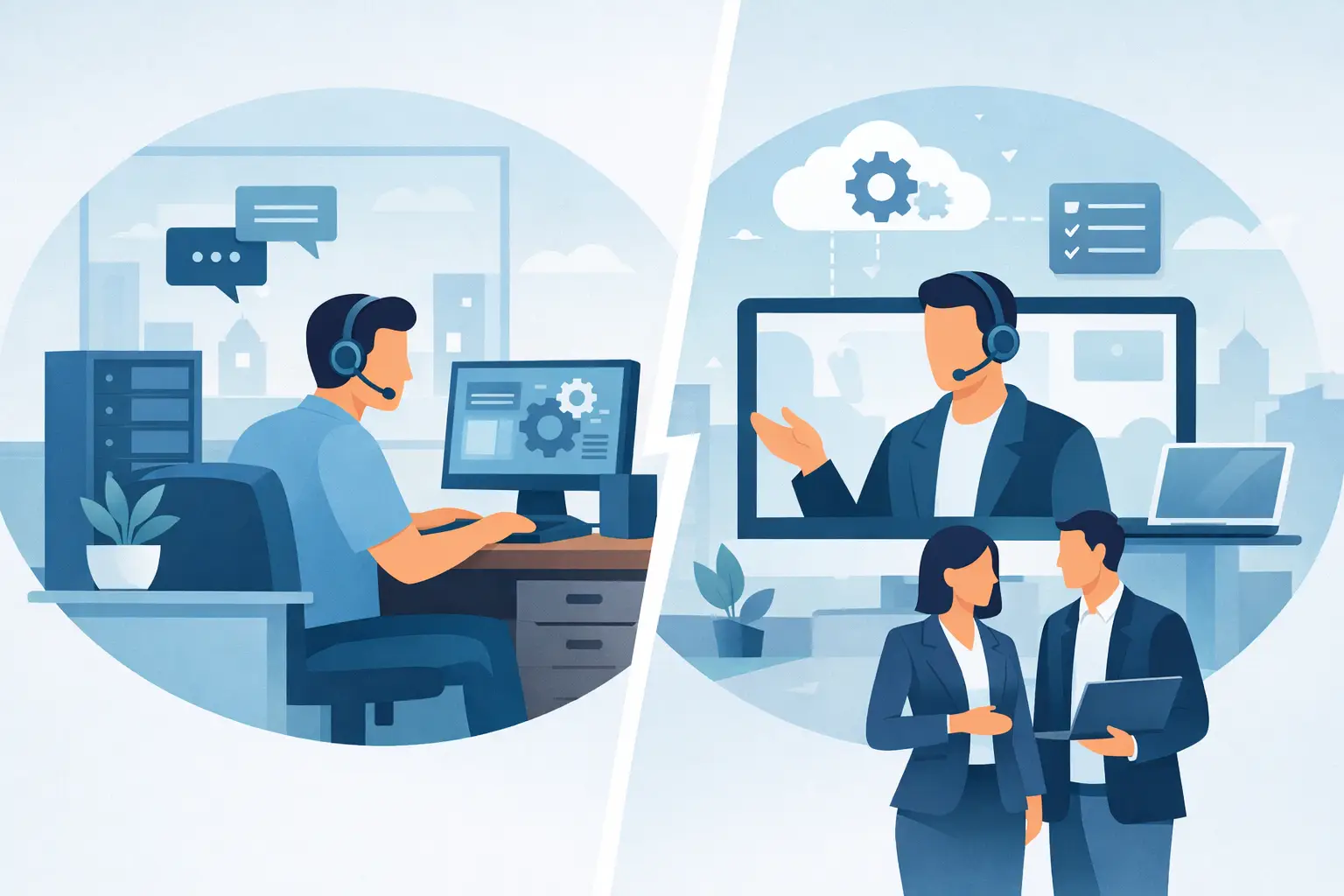
When the server refuses to cooperate in the morning, emails won't go out, and new security requirements land on the table at the same time, the question becomes very practical very fast: IT support in-house or outsourced? For many small and medium-sized companies, this isn't an abstract debate — it's a decision with direct consequences for productivity, risk, and cost.
Especially in the SME world, IT is often kept running for a long time through a lot of improvisation. An in-house contact "helps out" alongside their other duties, a service provider is only called in for acute problems, and strategic topics like IT security, backup, monitoring, or cloud migration keep getting pushed back. That works — until it doesn't. Then it becomes clear whether the chosen support model actually fits the company.
IT Support In-House or Outsourced: What It's Really About
The question is often framed too simply. It's not just about whether someone sits in-house or supports you from outside. What matters is whether your IT is run reliably, developed further, and properly secured.
In-house IT support generally means one or more employees at the company are responsible for systems, users, infrastructure, and often security topics too. External IT support means a specialized provider takes on these tasks in whole or in part. In between, there are many hybrid forms — for example, an internal IT coordinator with external support for helpdesk, monitoring, firewall, backup, or projects.
This distinction matters for SMEs. The best solution is rarely a purely ideological choice — it has to fit the company's size, budget, risk, and available expertise.
When In-House IT Support Makes Sense
An in-house solution can be very strong when IT has high strategic importance for the company and there's enough workload to justify dedicated specialist staff. Companies running complex in-house applications, coordinating many locations, or digitizing very specific processes often benefit from internal know-how that's deeply embedded in day-to-day operations.
An in-house IT employee knows the people, the workflows, and often the small quirks that never make it into any documentation. That can speed up decisions. It's also easier to coordinate day-to-day, since the same person is regularly on site and personally supports the various departments.
Still, this model has clear limits. In small companies, a lot of knowledge often rests with a single person. If that person is unavailable, things quickly turn critical. Vacation, illness, resignation, or overload aren't just HR issues then — they're a real operational risk. On top of that, a single administrator can hardly cover every topic to a consistently high standard today — from Microsoft 365 to networking and backup, right through to security, mobile device management, and compliance.
When External IT Support Is the Better Choice
External IT support is especially worthwhile when companies need professional IT but don't want to build a complete in-house IT department for economic reasons. That's the case for many small and medium-sized businesses. They need fast help with day-to-day issues, stable systems, protection against outages, and clear development of their infrastructure — but without the overhead of recruiting, training, and arranging cover.
An external partner usually brings broader expertise, because they work daily with different environments, manufacturers, and problem types. That helps especially with topics that are business-critical in many companies but rarely justify in-house specialist knowledge: firewall management, patch management, backup concepts, monitoring, cloud telephony, document management, or security assessments.
Economically, too, this model is often more sensible than it first appears. Instead of fixed costs for staff, training, tools, and downtime, you get a more predictable service framework. What matters here isn't just the monthly price. What's relevant is how much downtime, security risk, and internal effort are actually being avoided.
The Most Common Mistake When Comparing Costs
Many people compare only salary against service contract. That falls short. In-house IT costs more than just wages and benefits — it also costs time for recruiting, onboarding, training, cover arrangements, and the tooling landscape. On top of that come hidden costs when strategic topics get neglected or disruptions drag on too long.
External support, by contrast, sometimes looks more expensive, because its services are priced visibly. In fact, this transparency often makes decisions easier. Companies see more clearly which services they're buying, where the priorities lie, and which service levels make sense for their operations.
For SMEs especially, the most economical solution isn't the cheapest one — it's the most resilient one. If an outage stops sales, hampers production, or makes important documents unreachable, any supposed savings evaporate very quickly.
IT Security Is Now a Key Argument
The question of IT support in-house or outsourced becomes demanding at the latest when it comes to IT security. Cyberattacks have long since stopped targeting only large corporations. Mid-sized companies in particular are increasingly in the crosshairs, because they often hold attractive data assets while being more thinly staffed.
A single in-house IT manager can organize security very well — if they have the time, budget, and expertise. In practice, though, security often competes with day-to-day business. First the printer has to work, then the VPN access, then a new workstation needs setting up. Strategic security work quickly falls by the wayside.
An external partner can work in a more structured way here. Managed firewall, antivirus, monitoring, backup checks, patch management, and clear emergency processes ensure that security exists in practice, not just on paper. Especially given requirements like NIS2 and rising expectations from customers and insurers, this level of professionalism is becoming increasingly relevant.
Speed in Everyday Business: Who Helps When Things Go Wrong?
Many companies want one thing above all: problems solved quickly. Whether in-house or external works better depends heavily on how things are organized.
In-house IT is immediately reachable and knows the business. That's a real advantage day to day. At the same time, bottlenecks arise when too many issues run in parallel. A single contact person can, after all, only solve one problem at a time.
External support works especially well when processes are clearly defined, tickets are prioritized, and several specialists can step in as needed. Responsiveness then often increases significantly. The prerequisite, however, is a partner who doesn't just deliver technology, but is reachable, takes responsibility, and truly knows the environment. That's exactly what determines quality in practice.
The Best Solution Is Often Neither Purely In-House Nor Purely External
For many companies, a hybrid model is the most sensible answer to the question of in-house versus external IT support. An in-house contact person manages requirements, knows the departments, and sets priorities. The external IT partner handles operations, support, security services, monitoring, and projects as needed.
This model combines closeness to the business with broad specialist knowledge. It reduces the risk of relying on individuals, provides cover, and ensures operational topics don't crowd out all the strategic tasks. For growing companies especially, this is a pragmatic way to professionalize IT step by step.
Such an approach works particularly well when responsibilities are clearly defined. Who decides on investments? Who documents things? Who monitors backups? Who is responsible in an emergency? The more clearly these questions are answered, the more stable the collaboration runs.
Questions You Should Ask Before Deciding
Before committing, it's worth taking an honest look at your own situation. How dependent is your day-to-day business on working IT? How fast does help need to be available? What security requirements apply? Is there really enough know-how in-house — not just for today, but for the years ahead?
Scalability is just as important a question. If your company grows, new locations are added, or cloud solutions are used more heavily, support needs to be able to grow with it. A solution that works well with 15 employees can already be too slow or too fragile at 40.
The maturity of the existing IT also plays a role. If you already have cleanly documented systems, established processes, and clear responsibilities, you can manage a lot internally. Where structures are missing, external support often brings order, transparency, and reliability more quickly.
What Matters with an External Partner
If you're considering external IT support, technical expertise alone isn't enough. What matters most is availability, reliability, and an understanding of your business. A good partner doesn't sell technology for its own sake — they build solutions that fit the company.
Vendor-neutral consulting is a real advantage here. It helps align decisions with requirements rather than product specifications. Equally important are traceable service processes, clear responsibilities, and support that doesn't only become visible when something breaks. Ongoing monitoring, preventive maintenance, and clean documentation often make the real difference in the end.
This is exactly where experienced systems houses like WSV Systemhaus GmbH come in: as a long-term partner that brings together consulting, implementation, and ongoing support, and noticeably takes work off companies' hands in day-to-day operations.
The Right Decision Is the One That Takes Work Off Your Company's Hands
IT doesn't just need to run — it needs to fit your business. If in-house support delivers stability, speed, and security, it's a good solution. If external support reduces risk, adds know-how, and frees up resources, that's often the smarter path. And if a combination of both works better than either alone, that should simply be the answer.
The real question, then, isn't just whether in-house or external is better. The better question is which model ensures that your employees can work, risks stay manageable, and your IT grows along with your company.