
IT Outsourcing for Small Businesses
IT outsourcing for small businesses relieves teams, boosts security, and creates predictable IT costs - when strategy and partner fit.
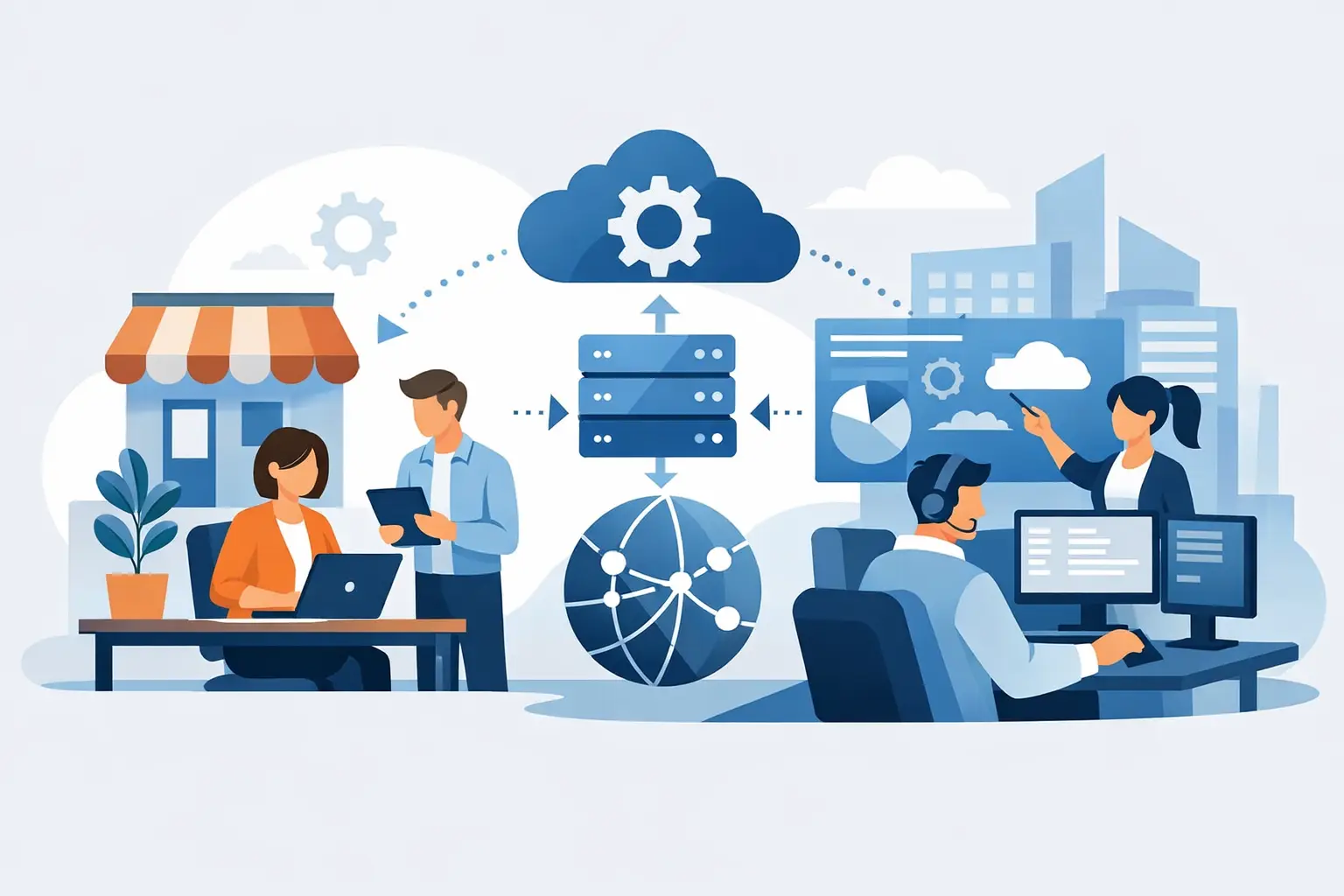
When the server stutters in the morning, emails don't arrive, and no one in the office has time to deal with it, it quickly becomes clear what IT outsourcing for small businesses is really about: not technology for its own sake, but a smooth working day. In small businesses especially, a lot often hangs on just a few people. If one of them is unavailable, or in-house IT know-how is missing, a small disruption quickly turns into a real business risk.
Why IT Outsourcing for Small Businesses Often Makes Sense
Small businesses face a familiar balancing act when it comes to IT. On one hand, requirements around security, availability, data protection, cloud applications, and mobile workplaces keep rising. On the other, there's usually no dedicated IT department that can continuously handle systems, updates, backups, and user requests.
This is exactly where IT outsourcing comes in. Certain IT tasks, or entire operational areas, are handed over to an external partner who takes on support, monitoring, helpdesk, and ongoing development. That relieves internal staff, establishes clear responsibilities, and ensures problems don't only become visible once operations have already ground to a halt.
For small businesses, this is especially interesting because it lets them buy in expertise without having to build up dedicated positions right away. At the same time, costs become more predictable. Instead of unpredictable individual invoices for emergencies, a clearly calculable model with defined services often emerges.
What Can Actually Be Outsourced
IT outsourcing doesn't automatically mean handing over your entire IT. In practice, a staged approach is often the sensible path. Some companies start with individual areas, such as backup or firewall management. Others outsource their entire ongoing IT operations.
Typical services include the employee helpdesk, support for servers and networks, managed security, patch management, backup concepts, cloud services, mobile device management, or workstation administration. Telephony, printer environments, and document management can also be part of an outsourcing model.
What matters isn't outsourcing as much as possible. What matters is outsourcing the tasks that tie up internal time, require special know-how, or are business-critical.
Which Problems Small Businesses Actually Solve This Way
Many managing directors think of cost first when it comes to this topic. That's understandable, but it falls short. The bigger benefit often lies in relief and risk reduction.
When employees with IT questions no longer have to ask "the colleague who's good with computers" but have dedicated support instead, that saves time for everyone. When systems are monitored and updates are rolled out in a controlled way, the likelihood of outages drops. When backups are checked regularly, an emergency doesn't just mean some backup is available — it means one that can actually be restored.
Security is another factor. Small businesses have long been on the radar of cyberattacks, precisely because they're often less protected than large organizations. Having firewalls, antivirus, access rights, and endpoints professionally managed doesn't grant absolute security — there's no such thing — but it delivers a significantly more resilient security posture.
IT Outsourcing for Small Businesses Isn't an All-or-Nothing Decision
A common misconception is: either you do everything in-house, or everything externally. In reality, hybrid models often work best.
A company with an in-house IT manager can, for example, cover first-level support itself while an external partner handles monitoring, security, backup, and infrastructure maintenance. Another business may have no in-house IT role at all and uses a service provider as an extended workbench for its entire day-to-day operations.
Seasonal differences matter too. Teams under heavy workload often don't need a large strategic IT department — they need a partner who is reliably reachable and pragmatically solves operational issues. This is a real advantage for growing companies especially, since IT can grow along with the business without immediately requiring new internal resources.
What Matters When Choosing a Partner
Not every outsourcing offer fits every company. Price alone is a poor yardstick. Cheap quickly becomes expensive if response times are unclear, responsibilities are blurry, or security standards aren't properly implemented.
What matters more is how the provider works. Are there fixed points of contact? Are services clearly described? Are systems actively monitored, or does the partner only react once something fails? How transparent are contracts, service hours, and billing models? And above all: does the service provider understand the company's workflows, or do they just deliver standard technology without an eye on practical benefit?
A good partner doesn't just talk about products — they talk about requirements. They ask about workstations, locations, business processes, data protection, failure scenarios, and growth plans. A fitting solution rarely comes out of a catalog — it comes from the interplay of technology, organization, and budget.
For many small and medium-sized businesses, regional proximity is also a genuine plus. Not because everything has to be solved on site, but because personal support, short distances, and a reachable point of contact carry real value day to day. Regionally rooted systems houses like WSV Systemhaus have built on exactly that for years.
The Most Common Concerns — and Which of Them Are Justified
There are legitimate reservations about IT outsourcing that deserve to be taken seriously. The first is loss of control. When an external partner manages the systems, the worry quickly arises that you no longer know what's actually happening inside your own company.
That worry is justified when roles, documentation, and access are poorly managed. It loses weight when the service provider works transparently, documents responsibilities cleanly, and makes decisions traceable. Good outsourcing models don't replace control — they organize it better.
A second point is dependency on one provider. That's a realistic concern too. That's why documentation, access rights, contract terms, and exit scenarios should be settled from the outset. Setting these up properly reduces the risk significantly.
Then there's the question of cost. Outsourcing doesn't automatically save money. It can even look more expensive than the previous improvised in-house solution. The difference usually only becomes visible once you factor in downtime, security incidents, extra internal burden, and a lack of predictability. The economically better solution isn't always the one with the lowest monthly price.
How to Get Started Without IT Chaos
The most sensible start is rarely a complete reorganization in one step. A structured look at the current situation works better. Which systems are in use? Where do recurring problems occur? Which applications are business-critical? Where are there security gaps or outdated processes?
Building on that, you can decide which areas should be stabilized or outsourced first. These are often topics like backup, endpoint security, firewall, Microsoft 365 environments, server maintenance, or employee support. Once this foundation runs cleanly, further services can follow.
It's also important to keep internal expectations realistic. An external IT partner takes work off your plate, but doesn't replace every decision within the company. Responsibilities on the customer side remain important — for approvals, priorities, or organizational changes. Outsourcing works best as a partnership, not as offloading.
When IT Outsourcing Pays Off Most
IT outsourcing for small businesses is especially worthwhile when growth, security requirements, and daily workload no longer match the existing IT structure. Typical signs include: disruptions piling up, no one feeling truly responsible, updates being neglected, new employees being set up on an improvised basis, or security questions constantly being postponed.
Regulatory requirements increase the pressure too. Anyone processing customer data, working mobile, or using increasingly digitized processes needs a higher degree of reliability. At that point, it's no longer enough to react only when called. What's needed is clear processes, documented systems, and a partner who doesn't just fix things but thinks ahead with you.
That doesn't mean every small business needs a large managed-service package right away. But almost every company benefits from putting critical IT areas on a more professional footing than before.
What Really Matters in the End
The best outsourcing solution isn't the most technically extensive one — it's the one that fits the business. A trade business has different requirements than a law firm, and a manufacturing company has different needs than a service provider with many mobile workstations. That's why IT outsourcing should always be connected to day-to-day business — to availability, security, speed, and what's actually feasible internally.
When an external partner ensures your employees can work reliably, security risks drop, and IT questions no longer keep blocking the workday, a lot has been gained. That's exactly when IT outsourcing stops being an abstract technology model and becomes practical relief that frees the company up to focus on its actual business.
Anyone ready to take the next step shouldn't first ask which technology is possible. The better question is: what IT does your company need so that day-to-day operations run smoothly and growth doesn't stall due to missing resources?