
Using Managed Services the Right Way for SMEs
Managed services for SMEs relieve your IT, boost security, and create predictable costs. What matters in choosing and running them.
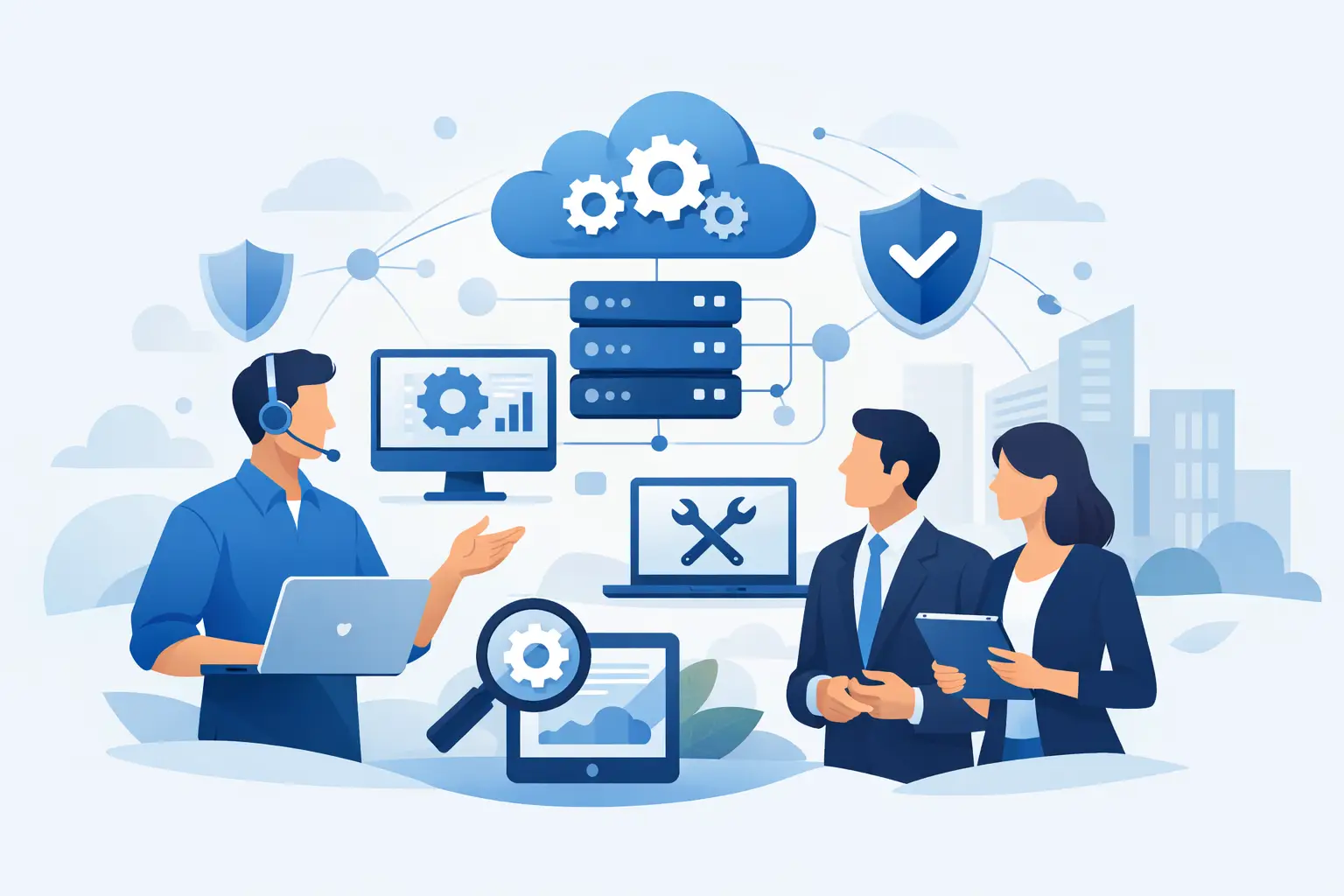
When the printer refuses to cooperate in the morning, then the phone system acts up, and shortly after an employee can't access important files, IT quickly turns into a real productivity factor — in the negative sense. This is exactly the point where managed services for SMEs become interesting: not as an abstract IT model, but as a practical answer to recurring outages, security risks, and a lack of internal capacity.
What Managed Services for SMEs Really Mean in Practice
Many small and medium-sized companies work with IT that has grown over the years. A server here, a cloud service there, plus a few individual security solutions and an external contact for emergencies. That often works fine — until disruptions become more frequent, requirements rise, or no one has the full overview anymore.
Managed services address exactly that. Instead of only reacting once something has already failed, an IT partner takes on clearly defined tasks within ongoing operations. Depending on what's needed, that can include monitoring, backup, firewall management, antivirus, endpoint management, or support for cloud and communication solutions.
For SMEs, this is especially appealing because not every company can, or wants to, build its own IT department. At the same time, expectations around availability, data protection, and security keep rising. Anyone processing customer data, working mobile, or connecting multiple locations needs more today than occasional support on an ad-hoc basis.
Why It's Worth Looking at Managed Services for SMEs
The biggest benefit is rarely just the technology. It's about relief in day-to-day business. Management, office administration, and internal IT staff all gain time, because not everything revolves around updates, alert messages, or recurring support cases anymore.
Better predictability comes on top of that. Instead of unpredictable costs from emergency callouts or the aftermath of outages, many managed-services models work with fixed monthly services. That makes budgets more calculable. For SMEs especially, that's often more important than a short-term bargain purchase.
The security level also rises when systems aren't just set up but continuously managed. A firewall only protects well if rules are maintained, anomalies are detected, and changes are properly implemented. A backup only helps if it runs reliably and data can actually be restored in an emergency.
The benefit, then, doesn't show up in a single measure — it shows up in the reliability of the entire operation.
Which Services Make the Most Sense for SMEs
Not every company needs the same package. A trade business with ten workstations has different requirements than a growing service company with remote work, multiple locations, and sensitive customer data. Still, there are areas where managed services for SMEs are especially often worthwhile.
Basic protection usually comes first. This includes managed firewall, antivirus, patch management, and ongoing monitoring of systems. These services ensure risks are spotted early and standard tasks don't get neglected.
Online backup is also very often a sensible starting point. Data loss doesn't only happen through cyberattacks. Deleted files, hardware failures, or user error occur far more often in daily life than many people think. A professionally managed backup creates real operational resilience here.
As mobility increases, mobile device management also becomes more important. When smartphones, tablets, and laptops are used for business purposes, trust alone isn't enough. Devices need to be centrally manageable, lockable if necessary, and properly integrated into security policies.
Cloud telephony and document management have also become topics in many SMEs where external support provides noticeable relief. Especially when processes are meant to become more digital, it's not just the rollout that matters, but stable operation afterward.
When Managed Services Shouldn't Just Be Off-the-Shelf
Standardized services have clear advantages. They're proven, economical, and quick to introduce. For many SMEs, that's exactly the right path, especially for topics like backup, endpoint protection, or firewall operations.
Still, not every IT setup is well served by a modular, off-the-shelf system. As soon as industry-specific software, particular compliance requirements, or older system landscapes come into play, a closer look is needed. At that point, it's not enough to just deliver products. What's needed is consulting, prioritization, and a concept that fits how the company actually works.
This is exactly where a pure provider parts ways from a true partner. Good managed services aren't oriented only around technical possibilities, but around business processes. The question isn't: which solution is modern? It's: which solution keeps your business running reliably and can be operated in an economically sound way?
How to Recognize the Right IT Partner
A good offer for managed services for SMEs doesn't start with technical jargon — it starts with questions. How critical are outages? Which systems need special protection? Are there internal IT resources, or should operations be largely outsourced? What response times are realistically needed?
Transparency matters too. You should be able to clearly see which services are included, where the limits lie, and how support works day to day. Especially with ongoing services, accessibility, fixed points of contact, and traceable responsibilities matter more than a long list of technical features.
Regional proximity can also be a real advantage. Not because every small issue needs to be solved on site, but because personal support builds trust and often makes complex projects easier. A systems house like WSV Systemhaus GmbH combines this proximity with ongoing operations, consulting, and implementation all from one place.
Common Objections – and What's Behind Them
Many companies hesitate because they fear losing control. When an external service provider takes over parts of the IT, the worry of becoming dependent quickly arises. That objection is understandable. The solution lies in cleanly documented responsibilities, transparent processes, and a partnership that isn't built on black-box models.
Cost is another point. Managed services look, at first glance, like an additional ongoing expense. Compared to unplanned outages, security incidents, or internal overload, that often looks different in practice. Still, it's true that not every service package pays for itself automatically. What matters is that the services match actual need.
There are sometimes internal reservations too. Employees may not want to feel monitored or restricted in how they work. That's why communication matters. Managed services aren't there to exercise control for its own sake. They create reliable workflows, raise security, and free teams from technical side battles.
How to Get Started Without Unnecessary Complexity
The best start is rarely complete outsourcing of the entire IT. For many SMEs, it makes more sense to begin with the areas where risk and relief are greatest. That's often backup, security, monitoring, or device management.
From there, you can expand step by step. Securing the most critical systems first quickly gives you a better picture of disruptions, weaknesses, and actual support needs. Building on that, further services can be added sensibly without overwhelming the organization.
It's important to honestly assess the current state. Are processes documented? Are administrator accounts properly managed? Is it clear which systems are business-critical? Without this groundwork, even a good service partner gets held back unnecessarily.
Managed Services as a Building Block for Growth and Security
SMEs are often under pressure from two directions. On one hand, processes should become more efficient, more digital, and more flexible. On the other, requirements around data protection, IT security, and availability keep rising. Handling both at once with limited internal resources is hard in day-to-day business.
Managed services don't create a theoretical ideal state, but they make IT more manageable. That provides operational relief and also creates room for strategic topics — such as modernizing infrastructure, moving to the cloud, or preparing for stricter security requirements.
Given topics like NIS2, mobile work, and a growing attack surface, it's becoming more important for many SMEs to operate IT professionally on an ongoing basis rather than just fixing it occasionally. That doesn't have to mean giving everything away. But it does mean concentrating responsibility where it can be reliably handled.
In the end, it's not about whether managed services sound modern or are currently in demand. It's about whether your IT supports your operations instead of holding them back. When systems run stably, risks become manageable, and someone is reachable day to day who doesn't just react but thinks ahead with you, external support turns into real added value.